


Apple AirPods 4 Wireless Earbuds with Active Noise Cancellation: A Complete Overview
Apple’s AirPods lineup has evolved considerably over the years, and the AirPods 4 with Active Noise Cancellation represent a notable step in that progression. This particular model brings active noise cancellation into an open-fit earbud design, a combination that has traditionally been reserved for earbuds with silicone tips. For listeners who prefer the feeling of earbuds that rest in the ear rather than seal inside the ear canal, this is a meaningful development. The AirPods 4 also introduce a redesigned shape, a smaller charging case, and a handful of software-driven features powered by Apple’s H2 chip. This review walks through what the product information tells us about the design, features, battery life, and practical use cases, so you can decide whether these earbuds fit the way you listen.
Design and Comfort
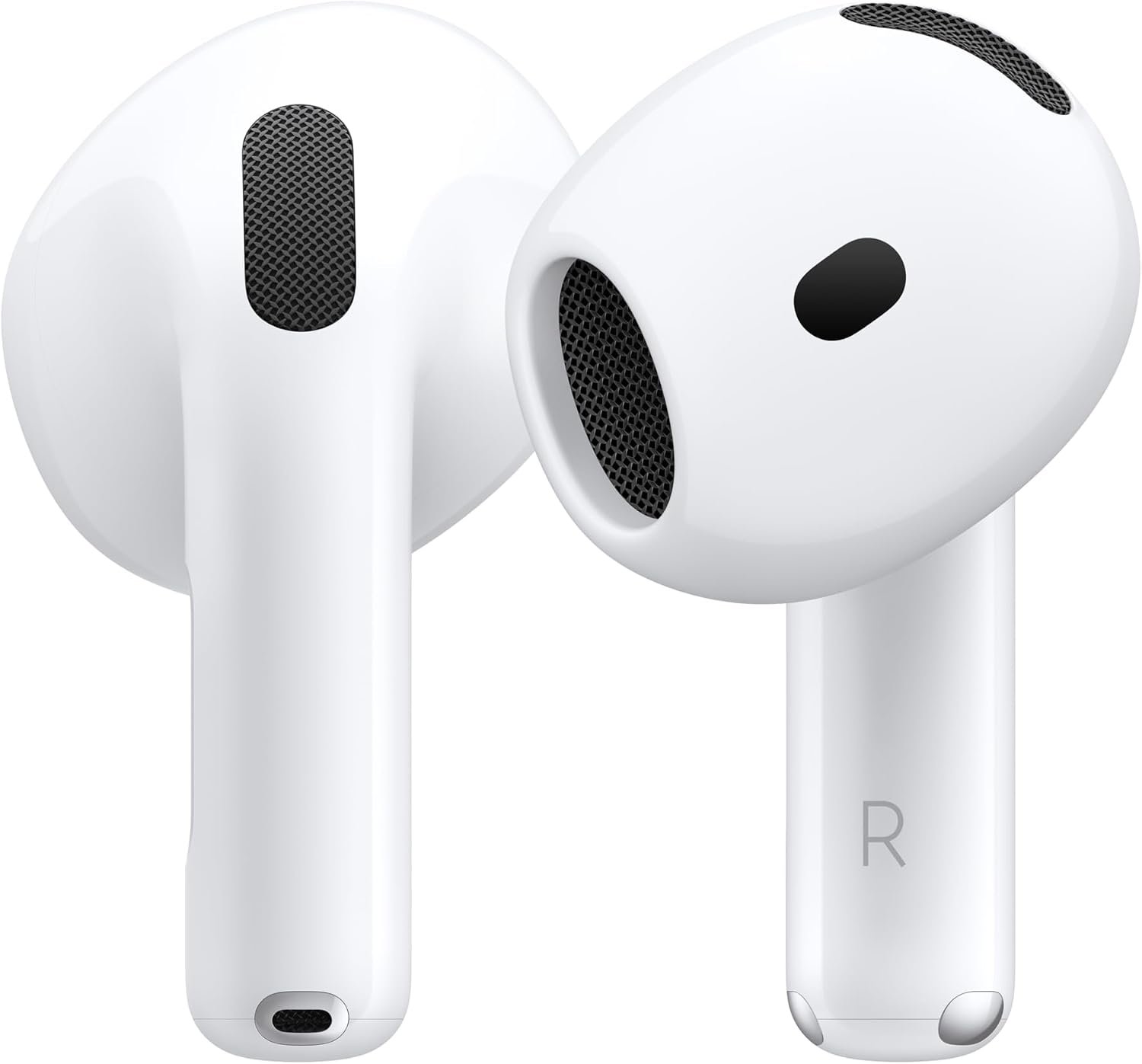
According to Apple, the AirPods 4 have been rebuilt for comfort. The company describes a refined contour and a shorter stem compared to earlier designs, with the goal of delivering all-day comfort and greater stability. That combination matters for an open-fit earbud, because without a silicone seal, the earbud relies on its shape to stay put during movement. The shorter stem also changes how the earbuds sit against the face, which can affect how they feel during longer listening sessions.
Controls have shifted as well. The AirPods 4 use quick-press controls for music and calls, which means playback and call management happen through pressing the stem rather than tapping. This is a design choice that some users find more deliberate than touch-based gestures, though the product information does not go into detail about how many presses correspond to which function.
The charging case has also been redesigned. Apple states that it is the smallest charging case in the industry with wireless charging. That claim is notable because wireless charging often adds bulk to a case, so keeping the footprint small while retaining wireless charging is a specific design achievement Apple is highlighting. The case supports charging via an Apple Watch charger, a USB-C cable, or a Qi-certified charger, giving users more than one way to top up.
Features and Technology
The H2 chip is central to the AirPods 4 experience. It enables Active Noise Cancellation, which Apple says helps reduce outside noise before it reaches your ears. In an open-fit design, this is a different proposition than noise cancellation in a sealed earbud, and Apple’s wording reflects that: the feature is described as helping reduce outside noise, not eliminating it entirely.
Adaptive Audio is another H2-powered feature. It seamlessly blends Active Noise Cancellation and Transparency mode, according to Apple. Transparency mode lets you hear and interact with the world around you as it sounds, while ANC reduces external noise. Adaptive Audio moves between the two depending on your environment, which Apple describes as providing the best listening experience in any environment. Conversation Awareness is a related feature: when you begin speaking with someone nearby, it automatically lowers the volume of what’s playing. Together, these features are designed to reduce the need to manually adjust settings throughout the day.
Personalized Spatial Audio with dynamic head tracking is also included. Apple describes it as placing sound all around you, creating a theater-like listening experience for music, TV shows, movies, games, and more. This is a feature that works across a broad range of content types rather than being limited to specific media.
Voice Isolation is another H2-driven capability. Apple states that it improves call quality in loud conditions by using advanced computational audio to reduce background noise while isolating and clarifying the sound of your voice for the person you’re speaking to. This is a stated product claim rather than an independently verified result, but it addresses a common pain point for calls taken in busy environments.
Everyday Experience and Siri Integration
The AirPods 4 include several conveniences that fit into daily routines. You can say “Siri” or “Hey Siri” to play a song, make a call, or check your schedule. Siri Interactions go a step further: you can respond to Siri by nodding your head yes or shaking your head no. This is a hands-free way to handle simple confirmations, which could be useful when your hands are occupied or when you’d rather not speak aloud.
Pairing is handled by placing the AirPods near your device and tapping Connect on your screen. Audio sharing lets you share a song or show between two sets of AirPods. An optical in-ear sensor detects when you’re wearing the earbuds, playing audio only when they’re in your ears and pausing when you take them off. The Find My app can help you track down your AirPods and charging case if they go missing. These are practical features rather than headline specs, but they shape how the earbuds fit into everyday use.
Battery, Charging, and Durability
Battery life depends on whether Active Noise Cancellation is enabled. With ANC on, Apple states you get up to 4 hours of listening time on a single charge and up to 20 hours using the case. With ANC off, total listening time extends to up to 30 hours. These figures are stated by Apple and reflect usage under the conditions the company defines, so real-world results may vary depending on volume, feature use, and other factors.
Durability is rated IP54 for both the AirPods 4 and the charging case. Apple describes this as dust, sweat, and water resistant, noting that the earbuds will withstand rain and heavy workouts. IP54 is a specific rating, and it’s worth noting that water resistance ratings are typically based on controlled testing conditions rather than everyday exposure, so the practical limits may differ from the rating’s intent.
Who Are the AirPods 4 Best For?
Based on the features described, the AirPods 4 with Active Noise Cancellation suit listeners who want an open-fit earbud rather than one with a silicone seal, but who still want noise reduction and transparency features. The redesigned contour and shorter stem are aimed at comfort and stability, which may appeal to people who wear earbuds for extended periods. The IP54 rating and Apple’s mention of rain and heavy workouts suggest the earbuds are intended to handle active use, though the rating itself defines the limits.
The Siri Interactions, Conversation Awareness, and Adaptive Audio features point toward users who move between environments and want the earbuds to adjust automatically rather than requiring manual changes. Audio sharing and Find My support add convenience for people already using Apple devices. The charging case’s support for Apple Watch chargers, USB-C, and Qi-certified chargers gives flexibility in how you keep the earbuds powered.
Final Verdict
The Apple AirPods 4 with Active Noise Cancellation bring together an open-fit design, the H2 chip, and a set of adaptive audio features in a package that Apple has redesigned for comfort and stability. The inclusion of Active Noise Cancellation in a non-sealed earbud is a notable choice, and Apple’s language around it—reducing outside noise rather than blocking it entirely—reflects the realities of that design. Battery life varies meaningfully depending on whether ANC is on, and the IP54 rating provides a stated level of dust, sweat, and water resistance for both the earbuds and the case.
For listeners who prefer the feel of open-fit earbuds and want features like Adaptive Audio, Conversation Awareness, Personalized Spatial Audio, and hands-free Siri interactions, the AirPods 4 present a coherent package. The smaller charging case with wireless charging support and the multiple charging options add practical value. As with any product, the suitability depends on your preferences and how you listen, but the features described here are clearly aimed at making the earbuds adaptable across different environments and activities.